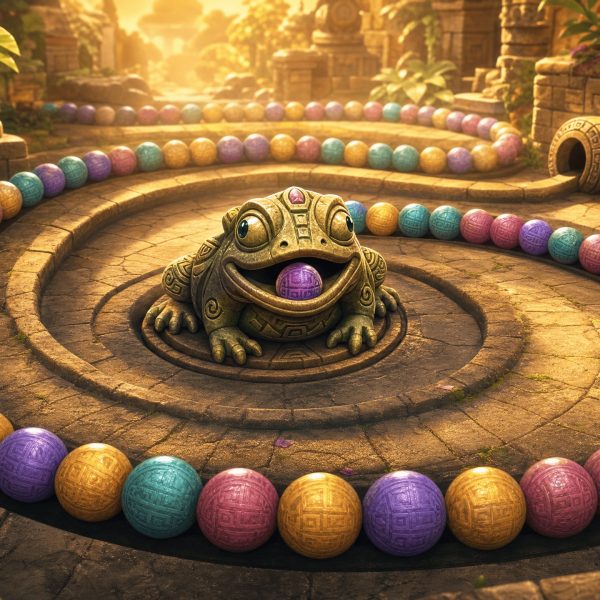
Most Zuma guides cover the same ground: match three, watch the chain, use power-ups. The tips below go further. They come from actual play — the small habits, specific moments, and counterintuitive moves that separate someone clearing levels at 80% from someone steady at 100%. Some are fundamentals you might have missed. Others are tactics most players never figure out on their own. All of them apply across the entire Zuma series, from the 2003 original to modern browser ports.
Aiming and Shooting Fundamentals
If you’ve never played the format before, start with the complete beginner’s guide — these tips assume you know the basics. The first four are the foundation everything else builds on.
- Pause before every shot. The chain isn’t as fast as panic suggests. A half-second to glance at your queue and the chain head will save more shots than reflexes ever will. Hesitation is cheaper than mistakes.
- Always check the next marble. The frog shows two colors — loaded and queued. Beginners think one shot ahead. Steady players think two. Every time you fire, look at what’s coming before committing.
- Aim at marbles, not gaps. A fired marble does not pass through the chain. It stops at the first marble it touches. Aim your cursor at a specific target marble, not at the empty space next to it.
- Use right-click constantly. Swap is not an emergency button — it’s part of the rotation. If your loaded color has no good landing, swap immediately and reassess. Most beginner mistakes are firing the loaded color out of habit.
Reading the Track and Managing Speed
Track awareness is the single biggest skill gap between casual and steady players. The chain is always moving, and where you look matters as much as where you aim.
- Watch the back of the chain, not the front. Beginners obsess over the head of the chain because it’s the prettiest target. But the pit is at the back. When the gap to the skull shrinks, prioritize back-of-chain shots even when they’re harder.
- Memorize the track on attempt two. You don’t need an optimized route — you just need to know where the curves and the pit are. After one failed run, you have all the spatial information you need to play smart.
- Track the chain head between shots. Don’t lose sight of where the leading marble is even when you’re aiming elsewhere. That single piece of awareness shifts your priorities mid-shot more than any other habit.
Chain Combos and Multi-Pop Setups
Three-matches keep you alive in early levels. Combos and chain reactions are how you survive late ones — and how you build a respectable score along the way.
- Stack matching colors when you don’t need them. If you have a green marble loaded with no good green target, fire it next to existing greens to build up a cluster. The next green will trigger a four- or five-marble pop instead of a basic three.
- Look for natural combos. When the chain has two same-color sections separated by a thin different-colored section, popping the middle section makes the two outer sections collide and pop too. Free chain reaction.
- Bigger pops mean more pushback. A three-marble match shoves the chain back slightly. A six-marble combo can buy several seconds. In tight late-game situations, hunt the biggest possible pops, not the easiest ones.
- The gap shot. When two same-color groups are split by a one-marble gap, fire that color into the gap to merge them. Aim for the exact gap — the marble lands between the groups and triggers the combined pop in one motion.
Power-Ups Guide
Power-ups in Zuma are situational tools, not trophies. Zuma's Revenge introduced the most varied set, but most modern marble-shooters use the same lineup: explosive, color-change, slow-down, reverse, and accuracy.
- Don’t hoard power-ups. Every level is a fresh slate — saved power-ups expire when the round ends. Use them when they help, not when they look impressive on the score screen.
- Reverse is your panic button — but only for true emergencies. When the chain is one second from the pit and you have no clean shot, fire reverse. Don’t waste it on situations a normal shot would handle.
- Slow-down is a late-level tool. The chain accelerates dramatically in the final stretch of every level. That’s when slow-down matters most. Using it during the calm opening minute is wasted time.
- Color-changing marbles set up combos. Fire one into a chain section to switch a marble to a useful color, then immediately follow with that color to trigger a multi-pop. The setup-plus-payoff is more reliable than waiting for a natural match.
Frog Tricks and Insertion Mechanics
The stone frog is your only tool, and a few of its mechanics are non-obvious. These are the moves most players never consciously notice — but they shape every shot you take.
- Insertion between matching colors triggers immediately. If you slot a green marble between two greens, that’s a three-match before the new marble even settles. Fire toward the gaps inside color groups, not the ends — it’s faster and creates better combo setups.
- The frog’s body doesn’t block your shot. Marbles travel in a straight line from the frog’s mouth, but only walls and chain marbles stop them. You can fire across the entire field freely as long as no chain segment is in the path.
- Lead the chain when it’s moving fast. A marble fired at a specific spot might miss because the chain shifted while your shot was traveling. In late levels, aim slightly ahead of where the target is now — where it will be by the time your marble arrives.
High-Score Strategy
Surviving a level and scoring well on it are different goals. The last three tips are for the players who already win consistently and want to climb leaderboards.
- Multi-pop combos stack score multipliers. Each consecutive pop in a single shot adds to a multiplier — a five-marble single-pop earns less than a three-plus-three combo. Hunting combos isn’t just safety; it’s the only path to high scores.
- The last-marble bonus rewards composure. Clearing the final marble of a level triggers a bonus and often a cinematic. Don’t rush the last 10% of the chain. Calm, accurate shots earn more than a flurry of clicks, and panic-firing at the end is where most clears go wrong.
- Stop panic-clicking in the final stretch. When the chain is close to the pit, beginners mash the mouse at whatever’s in front of them. Almost always, the right move is one calm shot at the back of the chain. Half a second of patience beats three seconds of chaos every time.
Frequently Asked Questions
Are there cheats for Zuma?
Not in any meaningful modern sense. The original PopCap Zuma Deluxe had a handful of debug-style codes that experienced PC players sometimes used, but those don’t apply to current browser-based versions. When players search for “Zuma cheats” today, they’re almost always looking for tips and strategy — which is exactly what this guide is.
What’s the best way to score high in Zuma?
Combos. Single three-marble pops give a base score; back-to-back chain reactions stack multipliers that quickly outpace anything you could earn through accuracy alone. Setting up four- and five-marble pops by stacking same colors before triggering them is the single highest-leverage scoring habit.
How do you set up chain combos in Zuma?
Two main techniques. First, stack same-color marbles in the chain when you don’t need to clear them yet, then trigger the buildup with one well-placed shot. Second, look for places where one pop will cause two other same-color sections to collide. The second technique is the source of the biggest natural combos — and the easiest to spot once you start looking.
When should you use power-ups in Zuma?
Late, not early. Slow-down and reverse are most valuable when the chain is near the pit, which is almost always in the final third of a level. Hoarding power-ups across multiple levels doesn’t work — they expire when each level ends. Aim to spend each one within the round you receive it.
How do you survive late levels in Zuma?
Three habits matter more than anything else: prioritize the back of the chain over the front when the pit is close, treat right-click swap as a regular tool instead of an emergency, and stop panic-firing in the last few seconds. Late-level Zuma rewards composure more than reflexes, and most losses come from rushing.
Do these tips work for Zuma’s Revenge and other versions?
Yes. The core mechanics are identical across the Zuma series and most marble-shooter clones inspired by it. Zuma’s Revenge adds split tracks and boss battles, which require some adapted prioritization, but the fundamentals — aiming at targets, leading fast chains, using right-click freely, hunting combos — translate directly.
Where to Apply These Tips
The classics are the best testing ground. Try the tactics above in Zuma Deluxe for the canonical experience, or work through the harder stages of Zuma's Revenge where insertion timing and combo setup matter most. If you want a lower-pressure environment to practice the back-of-chain habit and the gap shot, browse the Classic Zuma collection for browser versions with gentler pacing. Most of these tips click within an hour of deliberate practice — and once they do, they don’t go away.