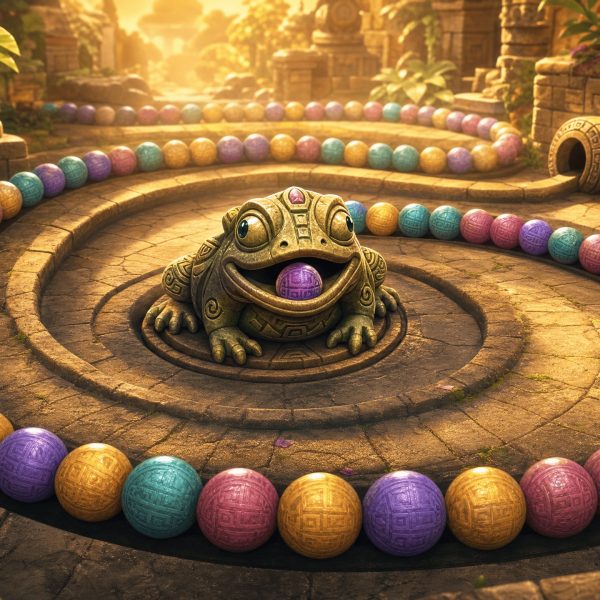
Zuma is a marble-shooter puzzle game built on one simple loop: a stone frog spits colored marbles, a chain of marbles snakes toward a skull pit, and your job is to clear the chain by matching three or more of the same color before it reaches the pit. This guide covers every part of how to play Zuma — controls, rules, frog mechanics, scoring, power-ups, and the small habits that separate panicked beginners from steady players.
What Is Zuma?
Zuma was released by PopCap Games in 2003 and quickly became one of the defining casual puzzle titles of the early 2000s. The desktop edition, Zuma Deluxe, brought the game to millions of home computers, and the 2009 sequel Zuma's Revenge added split tracks, boss fights, and a tropical island setting. EA acquired PopCap in 2011, but the core gameplay loop has never really changed.
The setup is always the same. You play as a stone frog idol sitting in the middle of an ancient temple. A chain of colored marbles emerges from a snake’s mouth and slowly winds along a fixed path toward a skull-shaped pit. If the chain reaches the pit, you lose. To survive, you fire marbles from the frog’s mouth into the chain and clear them by matching colors. That’s the entire game, level after level — the depth comes from how you aim, what you swap, and when you take risks.
Zuma Controls and Basic Setup
Zuma was built for the mouse, and almost every version still uses mouse-only controls. Three actions are all you need:
- Move the mouse. The frog rotates to follow your cursor.
- Left-click. Fires the marble currently loaded in the frog’s mouth.
- Right-click. Swaps the loaded marble with the next one in queue.
The frog always shows two marbles — the one ready to fire and the next one waiting (visible in the frog’s belly or beside it, depending on the version). That preview is one of the most important pieces of information on the screen, and most beginners ignore it for the first few levels. On touchscreen versions, the controls usually translate to tap-to-fire and tap-on-the-frog to swap. Some browser ports also bind the spacebar to swap, but the mouse remains the standard for desktop.
Zuma Rules: How the Game Works
The rules are easy to read once and forget about — but worth pinning down clearly.
Each level has a track: a fixed path the marble chain travels along. Some tracks are short and twisty; others are long, multi-loop affairs that fold back on themselves. The chain enters at one end (usually a stone snake’s mouth) and exits into the skull pit at the other.
Marbles in the chain come in a fixed set of colors per level — usually four to six. The frog fires the same colors. To make marbles disappear, you need a group of three or more of the same color touching each other in the chain. Match three, and they pop. If popping a group brings two same-colored sections together, those merge and check again, which is how chain reactions form.
You win a level by clearing every marble before the chain reaches the pit. You lose if even one marble crosses the pit threshold. There’s no health bar, no second chance per level — just the gap between the chain’s head and the skull. These are the marble-shooter rules every Zuma variant follows.
Zuma Frog Mechanics Explained
The stone frog is the only tool you have, and understanding what it can and can’t do shapes every shot.
The frog rotates freely 360 degrees and aims wherever your cursor goes. Marbles travel in a straight line from the frog’s mouth in the aimed direction. They do not bounce off walls. They do not arc. They do not pass through the existing chain — a marble hitting any part of the chain stops there and inserts itself.
That insertion behavior is the core mechanic. When your fired marble hits the chain, it slots in next to whichever marble it touched. If that creates a group of three or more of the same color, the group pops. If not, the marble simply stays in the chain, lengthening it by one. The two-marble queue (loaded plus next) is your planning tool. If the loaded marble is wrong for the shot you want, right-click to swap. Many beginners lose levels because they fire the loaded color out of habit instead of pausing for half a second to swap to the better one.
Match Mechanics, Combos, and Gap Shots
Three is the minimum match, but bigger matches are better. Popping four or five marbles in a single shot triggers chain reactions more reliably and earns more points. A few specific tactics matter once the basics click:
- Gap shots. If a same-color group is split by a small gap, you can fire a marble through that gap to land between them. The shot connects the two groups and pops everything in one move.
- Combos. When one pop causes two same-colored sections to meet and pop again, that’s a combo. Long tracks with mixed colors are combo gold.
- Last-marble bonus. Clearing the final marble of a level usually triggers a bonus and a short cinematic reward, but the chain often speeds up dramatically just before the end — don’t get greedy.
- Pushback. Larger pops physically shove the chain backward, buying you time. This becomes critical in late levels.
Most levels can be brute-forced with three-matches alone in the early game. Past the first dozen levels or so, you need combos and gap shots to keep up with the chain’s speed.
Reading the Track and Managing Speed
Every Zuma level lives or dies on track awareness. The chain doesn’t move at constant speed — it accelerates as you clear marbles, slows down briefly after big pops, and surges in scripted moments near the end of a level.
Curves slow the chain slightly. Long straight sections speed it up. The skull pit at the chain’s exit is the only place that ends the run, so prioritize the marbles closest to the pit when the gap shrinks. It feels counterintuitive — beginners often try to clear the front of the chain first because it looks easier — but the front of the chain is the safest part. The back, near the pit, is where the danger lives. Memorizing each level’s track shape after one or two attempts is enough; you don’t need to optimize, you just need to know where the pit is.
Power-Ups and Special Marbles
Most Zuma versions sprinkle in special marbles and power-ups that drop into the track or your queue. The exact set varies by title, but the common ones are:
- Explosive marble. Detonates a section of the chain. Useful when colors are scrambled and no clean three-match exists.
- Color-changing marble. Hits a marble in the chain and switches its color to whatever you fire next. Strong for setting up combos.
- Slow-down (turtle). Reduces chain speed for a few seconds. Save it for late-level surges.
- Reverse (backward). Pulls the chain backward, away from the pit. The single most valuable power-up in tight situations.
- Accuracy. Adds a laser sight to the frog. More of a quality-of-life tool than a game-changer.
In Zuma’s Revenge and most modern marble-shooters, special marbles drop from a coin counter — pop enough marbles, fill the gauge, get a power-up. Don’t hoard them. They expire if a level ends with them unused.
Beginner Tips for Your First Ten Levels
- Pause before every shot. The chain isn’t actually that fast in early levels. Glance at your queue, glance at the chain, then fire. Hesitation is cheaper than mistakes.
- Aim for the back of the chain when the pit is close. Front-of-chain pops are visually satisfying but won’t save you when the head is two seconds from the pit.
- Swap freely. Right-click is not a panic button — it’s part of the rotation. If your loaded color has nowhere to land cleanly, swap.
- Don’t fire into empty space. Marbles that miss the chain disappear. They don’t refund. Only fire when you can see where the marble will land.
- Look for color clusters. When two same-colored marbles are already touching in the chain, that’s your highest-value target.
- Treat power-ups as tools, not trophies. If you save a slow-down for a level you never finish, you wasted it.
Common Mistakes New Players Make
Three patterns show up over and over with new players. The first is firing on autopilot — left-clicking as soon as the frog has a marble, without checking the chain. This works for two minutes and breaks at level five.
The second is ignoring the next marble. The preview tells you what’s coming, which means you can plan two shots ahead instead of one. Most steady players think one shot ahead by default and two shots ahead in tight moments.
The third is panic-firing late in a level. When the chain is one second from the pit, beginners spam clicks at whatever’s in front of them. Almost always, the right move is one calm, accurate shot at the back of the chain — even if it means waiting half a second longer than feels comfortable. Zuma rewards composure more than reflexes once you’re past the first few levels.
How Difficulty Scales
Zuma games typically use a level structure with stages and individual rounds inside each stage. Early stages introduce mechanics gently — fewer colors, slower chains, simpler tracks. Later stages stack longer chains, more colors (up to six), faster speeds, and tracks that loop over themselves so you can’t always see where the chain head is.
The difficulty curve isn’t linear. There’s usually a noticeable jump around the middle of the game, where chain speed goes from manageable to demanding. That’s a deliberate pacing choice, not a bug. Most players need a few attempts on those middle levels before instinct catches up. The good news: the mechanics never change. If you know the basics from this guide, you have everything you need — what’s left is practice.
Frequently Asked Questions
Is Zuma free to play online?
Yes. Many versions of Zuma and marble-shooter games inspired by the original are available free in browsers, with no download or account required. The original PopCap Zuma Deluxe was a paid release, but countless free variations now exist.
Do I need to download anything to play Zuma?
No. Browser-based marble-shooter games run directly in modern browsers using HTML5. They work on Windows, Mac, Linux, Chromebooks, and most tablets without installation.
How many levels does Zuma have?
The original Zuma Deluxe had dozens of levels split across multiple stages, plus a separate gauntlet mode. Sequels and clones vary widely — some have a handful of stages, others hundreds. The structure is always the same: stages contain rounds, and you progress by clearing rounds in order.
What’s the difference between Zuma and Zuma’s Revenge?
Zuma’s Revenge (2009) added new mechanics on top of the original — split tracks where marbles travel along two paths simultaneously, boss battles against giant frog enemies, and lily-pad levels where the frog hops between platforms. The core matching loop is identical.
Is Zuma the same as Zumba?
No, and the names are easy to confuse. Zuma is a marble-shooter puzzle game from PopCap (2003). Zumba is a dance-fitness program. Different products, unrelated companies, similar-looking words.
What makes Zuma different from other match-3 games?
Most match-3 games (Bejeweled, Candy Crush) use a static grid where you swap adjacent pieces on your own turn. Zuma is real-time — the chain is always moving, so timing and aim matter as much as color matching. It’s closer in feel to an arcade shooter than a turn-based puzzler.
Where to Start Playing
If you’re new to the genre, start with the most forgiving versions before working up to the harder ones. The classic Zuma Deluxe and Zuma's Revenge are the gold standard, but their later levels are demanding. A free browser version with gentler pacing is a better first stop. Once you’ve cleared a few stages and the controls feel automatic, the original PopCap titles will feel rewarding instead of punishing. You can also browse the full Classic Zuma collection to find a variant that matches your pace.