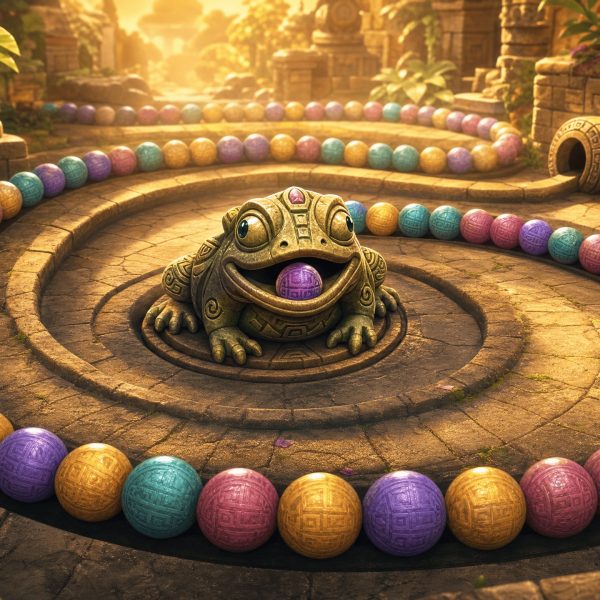
The story of Zuma stretches across more than two decades, dozens of platforms, one billion-dollar corporate acquisition, and a server shutdown that fans are still petitioning to reverse. This guide traces the complete history of Zuma games — from the December 2003 PC original to the franchise’s quieter present — with release dates, mechanics changes, and the context that turned a small Seattle studio’s marble-shooter into a household name.
Before Zuma: The Genre’s Origins
Zuma did not invent the marble-shooter format. The lineage traces back to Puzz Loop, a 1998 arcade game from Japanese developer Mitchell Corporation, released outside Japan as Ballistic. Puzz Loop introduced the core idea that Zuma would later popularize: a chain of colored objects moving along a fixed path, a fixed launcher in the center, and the goal of clearing the chain through three-or-more color matches before it reached an end point.
When PopCap Games released Zuma in 2003, Mitchell publicly claimed the game infringed on Puzz Loop’s design. PopCap maintained Zuma was not an exact clone, and PopCap co-founder and Zuma designer Jason Kapalka was on record saying he welcomed games being cloned by other developers as long as the new version added something to the original. Mitchell later re-released its design as Magnetica for the Nintendo DS in 2006. The dispute never resulted in legal action, and both games remain part of the marble-shooter genre’s foundation.
2003: PopCap Releases Zuma
Zuma launched on December 12, 2003 for Windows. It was developed and published by PopCap Games, the Seattle studio founded in 2000 by John Vechey, Brian Fiete, and Jason Kapalka — the same team behind Bejeweled. Kapalka served as Zuma’s lead designer, with music composed by Philippe Charron.
The premise was deceptively simple. A stone frog idol sits in the middle of an Aztec-inspired temple. A chain of colored marbles emerges from a snake’s mouth and winds along a fixed track toward a skull-shaped pit. The player rotates the frog with the mouse and fires marbles to make matches of three or more, clearing the chain before it disappears into the skull. That was the entire game, level after level.
The combination worked. Zuma won RealArcade’s Game of the Year award for 2004 and quickly became one of PopCap’s signature properties alongside Bejeweled. The original release also produced an enhanced edition, Zuma Deluxe, which became the canonical desktop version most players today still associate with the name.
2003–2009: Zuma Spreads Across Platforms
Few casual games of the early 2000s reached as many platforms as Zuma. Within a few years of the original PC release, the game appeared on Mac OS X (January 11, 2006), Xbox, Xbox 360 via Xbox Live Arcade, PlayStation 2, PlayStation 3 via PlayStation Network, PlayStation Portable, Palm OS handhelds, Windows Mobile, Java-based mobile phones, the iPod (in its pre-iPhone “click wheel” era), and even in-flight entertainment systems on commercial airlines.
The PlayStation 3 retail edition of Bejeweled 3 included Zuma as a bundled title alongside Feeding Frenzy 2, which exposed the game to a new generation of console players who hadn’t grown up with PopCap’s downloadable PC catalog. Critical reception across platforms was generally favorable — the Xbox 360 version scored 77 on Metacritic, the PS3 version 78. The mobile and handheld editions performed especially well in the Japanese and Korean markets, where casual puzzle games already had a strong foothold.
2009: Zuma’s Revenge! Arrives
After six years of platform expansion without a true sequel, PopCap released Zuma's Revenge! on September 15, 2009 for Windows and Mac. Where the original was content to refine a single mechanic, Zuma’s Revenge added several:
- Split tracks. Some levels featured two simultaneous chains traveling along separate paths, forcing players to manage threats on both sides.
- Boss battles. The game introduced six tiki boss fights — the first time the series broke from pure track-clearing into directed combat encounters.
- Lily-pad levels. The frog could hop between platforms in certain stages, abandoning its fixed central position for the first time in series history.
- Higher-resolution presentation. The game shipped with HD graphics built for the wider monitors and stronger hardware that had become standard between 2003 and 2009.
Zuma’s Revenge! followed its predecessor onto consoles and mobile. Versions appeared on Xbox 360, PSN, Windows Phone, iOS, and Java mobile. A Nintendo DS port released in February 2011 added daily challenges and a versus mode. The Xbox 360 retail box included Bejeweled 3 and Feeding Frenzy 2 as bonus titles — an echo of the bundling strategy used with the original Zuma a few years earlier.
2010: Zuma Goes Social with Blitz
By late 2010, Facebook was the fastest-growing gaming platform in the world, and PopCap had already proven the concept with Bejeweled Blitz. The natural next step was bringing Zuma into the same fast-session, friends-leaderboard format. Zuma Blitz launched on Facebook on December 14, 2010, billed by PopCap as “the social adaptation” of the franchise — its first competitive and cooperative iteration.
Blitz compressed the formula into one-minute rounds. Players raced to clear chains for high scores, competed against friends on weekly leaderboards, and unlocked frogs and power-ups through play and purchases. The Facebook page eventually accumulated millions of followers, and Blitz developed a devoted community that, by some measures, became more active than the original PC base. It was Zuma’s first venture into live-service gaming — and its last.
2011: EA Acquires PopCap
On July 12, 2011, Electronic Arts announced its acquisition of PopCap Games. The deal — reported at the time as one of the largest in casual gaming — folded PopCap and its catalog (Bejeweled, Plants vs. Zombies, Peggle, Zuma) into EA Interactive. PopCap remained headquartered in Seattle and continued operating as a subsidiary, but the strategic direction shifted toward mobile and live-service products.
The acquisition’s effect on Zuma specifically was a gradual quieting of new development. Plants vs. Zombies and Bejeweled continued to receive sequels and spinoffs, but the Zuma series saw no new mainline entries after Blitz. The three PopCap founders departed by 2014 — Brian Fiete in 2010 (before the EA deal closed), Jason Kapalka in early 2014, and John Vechey later that year. The team that designed the original Zuma was effectively gone from the studio that owned the franchise.
2017: Zuma Blitz Shuts Down
On March 31, 2017, EA took Zuma Blitz offline. The Facebook game’s servers were powered down, ending six and a half years of continuous live operation. As a parting gesture, PopCap made all in-game items free in the final weeks so players could enjoy what was left without paying.
The shutdown was met with disappointment from a community that had grown attached to the social experience. A Change.org petition asking EA to revive Zuma Blitz collected thousands of signatures. The petition is still online; Zuma Blitz is not. Because Blitz was server-side and tied to Facebook’s platform, no offline or archival version exists — the game cannot be played today by any official means.
The Legacy of Zuma Today
The Zuma series, as an active franchise from PopCap and EA, has been quiet for years. No mainline release has appeared since Blitz, and no announcements suggest one is in development. What remains is a long tail of influence.
The marble-shooter format Zuma popularized became a genre in its own right. Browser-based clones, mobile-store imitators, and “inspired by” titles fill app marketplaces by the hundreds. Some are direct copies of the Aztec aesthetic; others rework the formula with jungle, Egyptian, fantasy, or Halloween themes. The original PopCap titles — Zuma Deluxe and Zuma’s Revenge — remain available as downloadable purchases on platforms like the Origin/EA app and continue to find new players nostalgic for mid-2000s casual gaming.
For an audience that includes both adults who played the originals on family PCs and a generation discovering the format through browsers, Zuma occupies an interesting position: a finished story, technically, but a still-living gameplay loop. If you’re new to the format, the complete beginner’s guide to playing Zuma covers the rules and mechanics that have stayed constant across every entry on this timeline.
Zuma Games List in Chronological Order
- 2003 — Zuma (December 12, 2003, Windows). Original PC release by PopCap Games. Designed by Jason Kapalka.
- 2003–2008 — Zuma platform ports. The original game expanded to Xbox, Xbox 360 (Xbox Live Arcade), PlayStation 2, PSP, PlayStation 3 (PlayStation Network), Palm OS, Java mobile phones, iPod, Windows Mobile, Mac OS X (January 11, 2006), and in-flight entertainment systems.
- 2003 — Zuma Deluxe. Enhanced PC/Mac edition; the version most players still recognize today.
- 2009 — Zuma’s Revenge! (September 15, 2009, Windows + Mac). First true sequel. Added split tracks, boss battles, and lily-pad levels.
- 2009–2011 — Zuma’s Revenge ports. Released for Xbox 360, PlayStation Network, Windows Phone, iOS, Java mobile, and Nintendo DS (February 2011, with daily challenges and versus mode).
- 2010 — Zuma Blitz (December 14, 2010, Facebook). PopCap’s social/competitive iteration; one-minute rounds with leaderboards.
- 2011 — EA acquires PopCap (July 12, 2011). Franchise development slows.
- 2017 — Zuma Blitz shuts down (March 31, 2017). Servers taken offline; no archival version exists.
Frequently Asked Questions
When was Zuma first released?
Zuma was first released on December 12, 2003 for Windows. The Mac OS X port followed on January 11, 2006. Console and mobile versions rolled out gradually through the late 2000s.
Who created Zuma?
Zuma was developed and published by PopCap Games, a Seattle-based studio founded in 2000 by John Vechey, Brian Fiete, and Jason Kapalka. Kapalka served as the game’s lead designer, and Philippe Charron composed the music.
How many Zuma games are there?
The PopCap Zuma series has three core titles: the original Zuma (2003) and its enhanced Zuma Deluxe edition, Zuma’s Revenge! (2009), and the now-defunct Zuma Blitz (2010–2017). Beyond these, the original game was ported to a long list of platforms with minor variations, and countless unrelated marble-shooter games inspired by the formula exist across browsers and app stores.
Why was Zuma Blitz shut down?
EA took Zuma Blitz offline on March 31, 2017. EA did not publish a detailed reason, but the timing matched a broader industry shift away from Facebook-based social games as players migrated to mobile platforms. Because Blitz was a server-side game, it cannot be played today through any official means.
Is Zuma still being made?
No new mainline Zuma game has been announced or released since Zuma Blitz launched in 2010. EA acquired PopCap in 2011, and the franchise has been dormant for active development since. The original Zuma Deluxe and Zuma’s Revenge! remain available as downloadable purchases.
What was the first marble-shooter game?
The format predates Zuma. Mitchell Corporation’s 1998 arcade title Puzz Loop (released as Ballistic outside Japan) is generally considered the first game to use the moving-chain marble-shooter design. Zuma popularized the format for casual PC and mobile audiences five years later.
Where to Play Zuma Today
The classic PopCap titles remain available for purchase, and a wide range of free browser-based marble-shooters in the Zuma tradition can be played without download. Browse the Classic Zuma collection for Aztec-themed entries closest to the original, or try a free online version if you want to revisit the format without installing anything.