PopCap Games shaped casual gaming for a decade. Between 2000 and 2011, the studio behind Zuma, Bejeweled, Plants vs. Zombies, and Peggle redefined what “casual” meant — short sessions, instant satisfaction, mechanics so clean they felt obvious in retrospect. Then Electronic Arts bought PopCap in 2011, the studio shrank, Flash died in 2020, and a lot of people assumed the catalog went with it.
Most of it didn’t. Plenty of PopCap games are still playable today — some on mobile, some through EA’s services, some as faithful browser versions. This guide rounds up the ten best, with notes on where to find each one in 2026 and whether it still holds up.
How We Picked These Games
Three criteria. First, the game has to be genuinely playable in 2026 — not “exists on a dead distribution platform” or “requires a Flash emulator hack.” Second, the version available should keep the original feel; remasters are fine, mobile re-skins with aggressive monetization are not. Third, the game has to still be fun — not just nostalgically interesting. A few PopCap titles aged poorly. They’re not on this list.
The order isn’t strictly best-to-worst. PopCap’s catalog covers different genres, so #1 versus #5 isn’t apples-to-apples. We grouped by impact and accessibility.
1. Zuma Deluxe (2003)
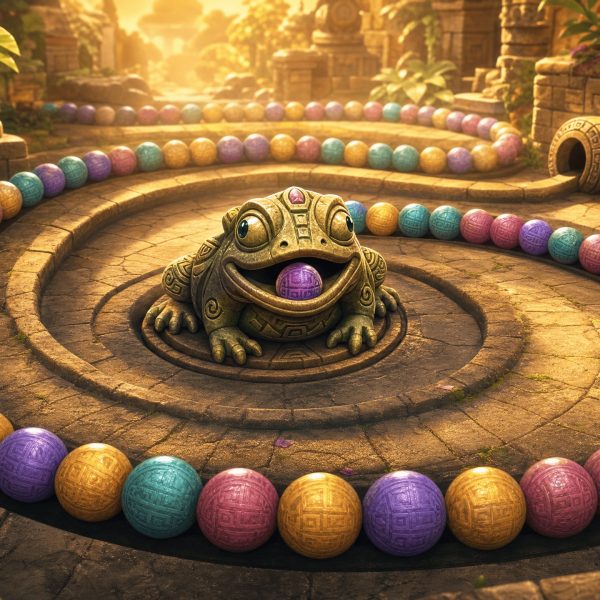
The marble shooter that launched a genre. You aim a stone frog at chains of colored marbles winding through Aztec temples and clear them before they reach the skull. Released in 2003, it was the game that made PopCap a household name in casual gaming.
Where to play in 2026: Free in your browser at zumagamesonline.com/games/zuma-deluxe-original/. The full original version, no download, no signup.
Why it still holds up: Pitch-perfect difficulty curves and a soundtrack you’ll hum afterward. Twenty-three years on, nothing’s been improved — only copied.
2. Zuma’s Revenge (2009)
The 2009 sequel that added boss fights, side-scrolling stages, and new frog tricks. More variety than the original, sometimes at the cost of the original’s purity.
Where to play in 2026: Free in your browser at zumagamesonline.com/games/zuma-revenge/. Also available on Steam and through EA’s services for PC.
Why it still holds up: Tiki bosses are memorable. The variety helps it stay fresh longer than Deluxe. If you’ve finished the original, this is the obvious next stop.
3. Bejeweled (2001) and Bejeweled 3 (2010)
The match-3 game that started everything. Match three or more gems of the same color, watch them disappear, watch new gems fall in. Bejeweled invented a category that now includes Candy Crush, Royal Match, and a thousand mobile clones.
Where to play in 2026: Bejeweled 3 is the most-recommended modern version — available on Steam and through EA’s services. The original Bejeweled has free browser-style versions; quality varies.
Why it still holds up: The base mechanic is timeless. Bejeweled 3 added enough modes (Zen, Diamond Mine, Lightning) to keep replay deep without ruining the simplicity.
4. Plants vs. Zombies (2009)
The tower defense game where you plant peashooters to stop a slow zombie invasion of your suburban lawn. Plants vs. Zombies sold across every platform PopCap could reach, then some.
Where to play in 2026: Available on PC through EA’s services and on mobile via the App Store and Google Play. The original — not the free-to-play sequel — is the one to find.
Why it still holds up: Dialed-in pacing and one of the catchiest opening songs in casual gaming history. Plays well even on a tablet.
5. Peggle (2007)
Drop a ball into a board full of pegs, hit the orange ones, listen to “Ode to Joy” play when you win. Peggle is built around a simple physics loop dressed up in absurd unicorns-and-rainbows visuals.
Where to play in 2026: Peggle Deluxe and Peggle Nights remain available through EA’s services and on Steam. Mobile versions exist but vary in quality.
Why it still holds up: The “victory moment” when a single shot clears the board is unmatched. Quick sessions, no commitment, instant satisfaction.
6. Bookworm (2002)
A word game where you connect adjacent letter tiles to form words. The longer the word, the better the score. Long enough, you delay the burning red tiles that creep up from the bottom.
Where to play in 2026: Multiple browser-based clones exist; the original PC version still circulates in PopCap collections through EA. Mobile re-releases exist but lean into ads.
Why it still holds up: Word games scale with vocabulary, not reflex. A casual genre that genuinely rewards thinking. Quietly addictive.
7. Chuzzle (2005)
A match-3 game with fluffy, googly-eyed creatures called Chuzzles. You shift them around the grid until matching colors line up. The Chuzzles squeak, blink, and complain when you click them.
Where to play in 2026: Browser-based versions still exist on casual game portals. Quality varies — some are faithful, some are light reskins.
Why it still holds up: The character work. Bejeweled mechanics with personality. A lot of “cute match-3” games tried this formula afterward and missed the charm.
8. Feeding Frenzy (2004) and Feeding Frenzy 2 (2006)
You play a small fish. You eat smaller fish. You become a bigger fish. You eat bigger fish. Repeat until you reach the top of the food chain. Simple, satisfying, slightly grim.
Where to play in 2026: Browser-style ports exist on casual game portals. The original PC version is harder to track down legitimately, but Feeding Frenzy 2 sometimes appears in EA bundles.
Why it still holds up: The growth loop is one of the cleanest in casual gaming. Quick wins, constant progression, low pressure.
9. Insaniquarium (2001)
A pet management game where you feed virtual fish, sell their coins to buy upgrades, and defend against alien attacks. PopCap’s earliest hit, and a clear ancestor of Plants vs. Zombies’ rhythm.
Where to play in 2026: Browser-based versions are scattered across casual portals. The original PC version sometimes appears in EA-curated collections.
Why it still holds up: Slow, calming, with just enough resource management to feel rewarding. Aged surprisingly well for a game from 2001.
10. Plants vs. Zombies 2 (2013)
The free-to-play mobile sequel. More plants, more zombies, more world tours. The monetization is heavier than the original — energy timers, premium plants — but the core game is still recognizably Plants vs. Zombies.
Where to play in 2026: Free on the App Store and Google Play. Active updates continue from EA’s mobile team.
Why it’s on this list: If you want a PopCap game you can launch right now on your phone, no setup, this is it. Just expect prompts to spend money.
What Happened to PopCap
Electronic Arts acquired PopCap in 2011 for around $750 million. The independent studio that built Zuma and Bejeweled became part of a giant publisher. The next few years saw mobile-focused releases (Plants vs. Zombies 2, Bejeweled Blitz updates) and shrinking attention to the legacy desktop catalog.
Most of the 2000s PopCap output drifted to “still buyable, sometimes” status. Mobile became the default. The studio name still appears on releases, but the original team has long since dispersed. For the full story, see our history of Zuma games — much of PopCap’s trajectory is told through the Zuma series.
Frequently Asked Questions
Are PopCap games still made?
Yes, but rarely. Most active PopCap-branded development now goes to Plants vs. Zombies sequels and mobile updates of legacy titles. Original new IP from PopCap has been quiet for years.
Can I play PopCap games for free in 2026?
Some of them. Zuma games run free in browsers (see our catalog). Plants vs. Zombies 2 is free-to-play on mobile. Most PC originals (Bejeweled 3, Peggle, Plants vs. Zombies) require purchase or an EA subscription.
Is PopCap shut down?
No. PopCap still exists as a studio under EA. Active output is much smaller than its 2005–2011 peak, but the brand isn’t dead — just quieter.
Which PopCap game is the best?
It depends what you want. For pure casual mastery, Zuma Deluxe. For brain training, Bookworm. For physics satisfaction, Peggle. For tower defense, Plants vs. Zombies. None of them is objectively “the best” — they cover different genres.
Are PopCap games on Steam?
Some. Bejeweled 3, Peggle Deluxe, Peggle Nights, Plants vs. Zombies, and Zuma’s Revenge are typically available on Steam. The exact lineup changes occasionally as EA shuffles its catalog.
Why don’t old PopCap games work in browsers anymore?
Most originals depended on Flash, which was retired at the end of 2020. The games themselves still exist as installable PC software, but the browser versions died with Flash. The exception: marble shooters like Zuma have been ported to HTML5, so the browser experience continues.
Final Thoughts
PopCap’s golden run was 2003–2010. Most of what came out then is still playable now, in some form — sometimes free in a browser, sometimes for $5 on Steam, sometimes wrapped in mobile microtransactions. The mechanics have aged better than the surrounding business.
If you only have time for one, start with Zuma Deluxe — it’s free, instant, and the cleanest example of what PopCap did best. From there, branch into whichever genre you missed: word, match-3, tower defense, physics. The catalog rewards exploration.
Related Reading
- 10 Best Zuma Games to Play Online in 2026 — if Zuma is the PopCap game that hooked you.
- The Complete History of Zuma Games — the PopCap story told through its biggest hit.
- How to Play Zuma — Complete Beginner’s Guide — for anyone new to marble shooters.
- Classic Zuma Games — every PopCap-era marble shooter we host.