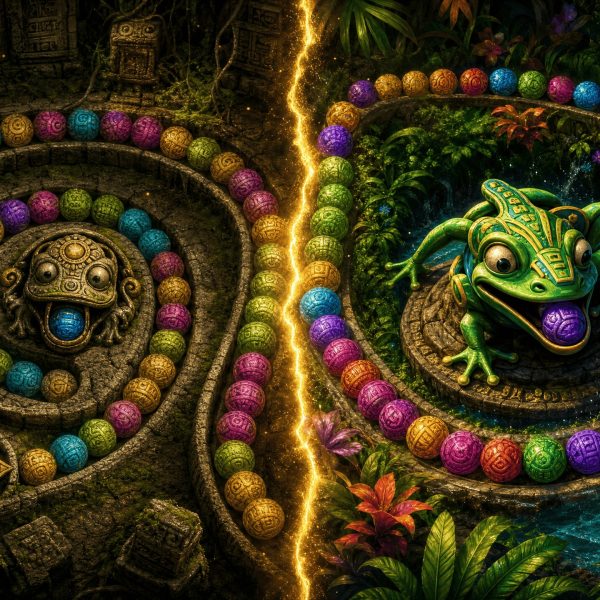
Zuma and Bubble Shooter both involve firing colored balls at a wall of more colored balls and matching threes to clear them. From a distance they look like the same game. They’re not. Zuma is a real-time reflex puzzle where a chain advances toward a pit; Bubble Shooter is a turn-based aim puzzle where bubbles wait for you to fire. The mechanics overlap, but the actual feel of playing each is completely different. This article breaks down the real differences and which one suits which type of player.
TL;DR — The Quick Verdict
If you want pressure, reflexes, and combo chains: Zuma. If you want calm, geometric aim puzzles you can pause-think your way through: Bubble Shooter. Both share the genre family of “aim and match,” but Zuma rewards timing while Bubble Shooter rewards strategy. Neither is objectively better — they’re built for different temperaments, and most casual-puzzle players end up enjoying both for different moods.
At a Glance: Side-by-Side Comparison
The table below covers the core mechanical differences. The rest of the article unpacks each one in detail.
| Feature | Zuma | Bubble Shooter |
|---|---|---|
| Genre | Marble shooter | Bubble shooter |
| Origin | PopCap Games, 2003 | Taito (Puzzle Bobble), 1994 |
| Direction of threat | Chain moves laterally along a path | Bubbles descend from the top |
| Launcher position | Center of the screen (stone frog) | Bottom of the screen |
| Pacing | Real-time, always moving | Turn-based; you fire when ready |
| Time pressure | High — chain races to the pit | Low — bubbles wait for shots |
| Failure condition | Chain reaches skull pit | Bubbles touch the bottom line |
| Wall bouncing | None — straight-line shots only | Yes — banking off side walls is core |
| Typical session length | 3–10 minutes per level | 1–5 minutes per level |
| Primary skill | Reflexes plus combo planning | Geometry plus aim planning |
How They Actually Play Differently
Chain Direction and Spatial Setup
In Zuma, a chain of marbles enters at one end of the screen and winds along a fixed path — often curved or spiraled — toward a skull-shaped pit at the other end. The frog launcher sits in the middle of the temple and fires in any direction. Your spatial challenge is reading curves and targeting moving sections of chain.
In Bubble Shooter, the playing field is a top-down grid. Bubbles fill the upper portion of the screen, and the launcher sits at the bottom firing upward. There’s no laterally-moving chain — the wall of bubbles is mostly stationary, descending only when you waste shots without scoring matches. Your spatial challenge is geometric: planning angles, banking shots off side walls, and clearing whole columns to drop floating clusters.
Pacing and Time Pressure
This is the single biggest difference between the two games. Zuma’s chain is always moving. Even when your hand isn’t on the mouse, the chain advances toward the pit. Hesitation costs ground. Late-level Zuma is genuinely tense — you have to read the chain, plan a shot, and execute under continuous time pressure.
Bubble Shooter, in its classic form, is turn-based. The bubbles don’t move while you aim. You can sit and stare at the board for thirty seconds without consequence. The launcher fires only when you click. Bubbles descend a row only after several shots without a match, and the threshold varies by implementation. The result is a fundamentally different experience: Bubble Shooter is contemplative, Zuma is reflexive.
This single difference shapes everything else about how the two games feel. It’s why some players swear by one and bounce off the other after fifteen minutes.
Aiming and the Launcher
Zuma’s frog rotates a full 360 degrees and fires marbles in straight lines. They don’t bounce off walls. They don’t arc. They stop at the first marble in the chain they touch.
Bubble Shooter’s launcher fires in a 180-degree arc upward, and the bubbles can — and often must — bounce off side walls. Banking shots off walls to reach corners is a core skill in Bubble Shooter; it doesn’t exist at all in Zuma. This is why Bubble Shooter rewards geometric thinking in a way Zuma simply doesn’t, and why Zuma rewards target-tracking in a way Bubble Shooter doesn’t.
Power-Ups and Variation
Both genres have power-ups, and the lineup is partly shared (bombs, color-changers, slow-downs in Zuma; bombs, fireballs, color swaps in Bubble Shooter). Zuma’s power-ups are deeply tied to chain progression — slow-down only matters when speed matters, reverse only matters when the chain is near the pit. Bubble Shooter’s are more situation-based, helping when the board layout gets awkward. Zuma’s power-up strategy is about timing; Bubble Shooter’s is about board reading.
Difficulty and Skill Curve
Zuma’s difficulty curve is built around speed. Early levels are slow; late levels are not. Skill in Zuma equals reflexes plus planning plus combo recognition. The skill ceiling is high because perfect play earns chain-reaction multipliers that compound dramatically.
Bubble Shooter’s curve is built around board complexity. Early levels are sparse; late levels have dense, oddly-shaped clusters of bubbles. Skill equals aim plus geometric planning plus power-up management. The ceiling is also high but in a different direction — pro Bubble Shooter players bank impossible shots and clear boards in stretches normal players can’t conceive of.
A skilled Zuma player isn’t necessarily a good Bubble Shooter player, and vice versa. The two genres train different mental muscles.
Where Zuma Wins
Zuma wins on intensity. The real-time chain creates a building tension that bubble shooters simply don’t replicate. Combo chains in Zuma — a three-match triggers a four-match triggers a six-match — are genuinely exhilarating in a way that turn-based matching can’t be. The aesthetic also wins: the Aztec-temple setting, the stone frog, the snake-mouth chain entry, the skull pit are iconic in a way Bubble Shooter’s generic graphics aren’t. Zuma’s level design is more deliberate, with carefully chosen tracks that reward memorization. And the franchise has a real identity — Zuma’s Revenge, Zuma Blitz, the broader history of Zuma games — that elevates it above generic matching.
Where Bubble Shooter Wins
Bubble Shooter wins on accessibility. No time pressure means anyone can play — kids, casual users, players who just want to relax for a few minutes. Sessions can be one minute or one hour, and the game doesn’t punish either choice. The free-to-play browser ecosystem around Bubble Shooter is enormous; you can find a hundred competent implementations in five seconds of search. The geometric puzzle layer (bouncing off walls, planning angles, dropping clusters) is genuinely deep for players who enjoy spatial reasoning. And the no-stress format makes Bubble Shooter ideal for breaks at work, late-night phone sessions, or unwinding without the stress Zuma can deliver in late levels.
Zuma or Bubble Shooter: Which Should You Play?
Decide based on temperament rather than mechanics. If you enjoy the building tension of arcade games, prefer real-time challenge over turn-based puzzles, and want a game with depth that rewards practice, play Zuma. If you prefer to think through your moves at your own pace, want something that fits any session length, and value accessibility over intensity, play Bubble Shooter.
If you’re not sure, try fifteen minutes of each and notice which one made the time disappear faster — that’s your answer. Most players find they have a clear preference within a single session.
Can You Enjoy Both?
Most players who like one ultimately enjoy the other, just for different moods. Zuma is a focused-attention game; Bubble Shooter is a relaxed-attention game. They occupy different slots in a casual puzzle rotation. Many people who started with one in the early 2000s ended up enjoying both by the late 2010s — the two genres don’t compete for the same playing time. If you’re looking for more options in either direction, our guide to Zuma alternatives covers both genres in depth.
Frequently Asked Questions
Is Zuma harder than Bubble Shooter?
Generally yes. Zuma’s real-time pressure makes early levels harder for new players because there’s no time to think. Bubble Shooter is more forgiving for beginners. At high skill levels, both genres have steep difficulty ceilings, but they reward different skills — Zuma rewards reflexes and timing, Bubble Shooter rewards geometric planning and precision aim.
What’s the difference between Zuma and Bubble Shooter?
The core difference is direction and pacing. Zuma is a marble-shooter where a chain of marbles moves laterally along a fixed path toward a pit, and you fire from a central launcher under real-time pressure. Bubble Shooter has bubbles descending from the top of the screen, with a bottom-mounted launcher that can bank shots off side walls, and gameplay is turn-based without time pressure. Both share the “match three or more colors to clear” mechanic but feel completely different to play.
Which came first, Zuma or Bubble Shooter?
Bubble Shooter. The bubble-shooter genre originated with Puzzle Bobble (also known as Bust-A-Move) by Taito in 1994, nearly a decade before Zuma launched in 2003. The marble-shooter format itself traces back to Puzz Loop (1998, by Mitchell Corporation), making both genres roughly contemporaneous in their mid-1990s arcade origins, with Bubble Shooter slightly older.
Do the same skills apply to both games?
Some, not all. Color matching, combo recognition, and basic aiming transfer between them. But Zuma’s timing and reflex demands are different from Bubble Shooter’s geometric and banking-shot demands. Being good at one doesn’t automatically make you good at the other — they reward different cognitive strengths.
Is Bubble Shooter free? Is Zuma free?
Most browser-based Bubble Shooter implementations are free, with optional purchases in mobile versions. The original PopCap Zuma Deluxe is a paid download, but free browser ports of Zuma exist as well. Both genres are accessible without significant cost in 2026, especially in browser form.
Which one is better for older players?
This is more about temperament than age, but Bubble Shooter’s lack of time pressure makes it generally easier for players who prefer slower-paced thinking. Zuma’s reflex demands can frustrate players who don’t enjoy real-time challenge. That said, plenty of players in their 60s and 70s play Zuma daily — preference matters more than age.
Where to Start
If you’re choosing your first marble-matching game, try a free browser version of Zuma for the real-time experience and a generic Bubble Shooter for the turn-based one. A 15-minute session of each is enough to know which suits you. If you decide Zuma is your speed, our complete beginner’s guide covers the rules and mechanics in detail, and the 2026 ranking of the best Zuma games points toward the strongest options to play next.
Free games mentioned here
- Zuma Deluxe Original — the real-time side of the comparison, free in your browser
- Zuma Bubble Shooter — the bubble-shooter side, same catalogue
- Marbles Garden — another Marble Shooters title if you want a third opinion