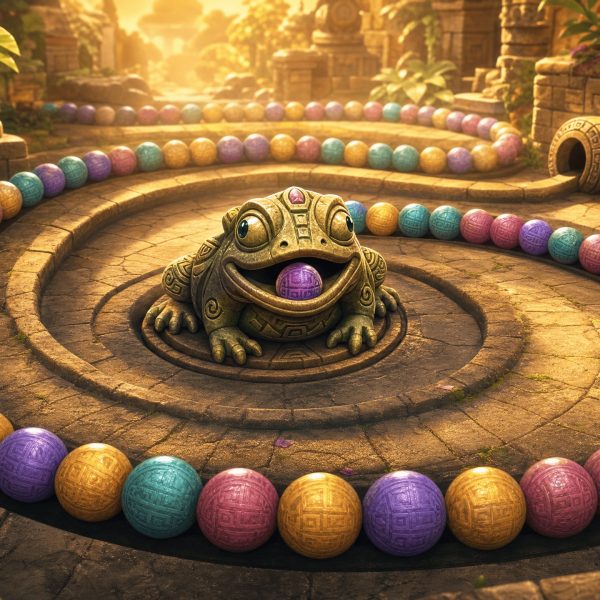
If you’ve cleared every Zuma game you can find and you’re still hungry for the same flavor of real-time chain-clearing, the marble-shooter genre extends well beyond PopCap’s catalog. Below are 12 games like Zuma — some near-clones, some loose cousins — ranked by how close they actually feel to the original. The first five are direct alternatives in the same genre. The rest are adjacent puzzlers that scratch a similar itch even if the mechanics differ. If you haven’t played the actual Zuma franchise yet, start with our 2026 ranking of the best Zuma games first; this list is for after.
How These Alternatives Were Picked
Three criteria shaped this list. First, gameplay similarity — does the game share Zuma’s specific real-time, color-matching, chain-clearing core, or just a generic “casual puzzle” feel? Second, quality and availability in 2026 — is it still actively playable on platforms most readers can access? Third, distinctiveness — does it offer something Zuma doesn’t, or is it just a worse copy? Games on this list ranked on at least two of those three criteria. The list is split into three tiers: direct marble-shooter alternatives, bubble-shooter cousins, and adjacent puzzlers. The closer a game is to the top of its tier, the closer it feels to actual Zuma play.
Tier 1: Direct Marble-Shooter Alternatives
These are the games that share Zuma’s exact format: a chain of colored objects moving along a fixed path, a launcher firing matching colors, the goal of clearing the chain before it reaches an end point. If you want what Zuma offers, look here first.
1. Luxor
The closest game to Zuma ever made; Egyptian theme.
Luxor (2005, MumboJumbo) is so similar to Zuma that the genre is sometimes just called “Zuma/Luxor.” Spheres roll along a path pushed by a scarab, you fire colored marbles from a winged shooter at the bottom of the screen, the spheres die before they reach the pyramid. The series spans Luxor: Amun Rising (2005), Luxor 2 (2006), Luxor 3, Luxor: Quest for the Afterlife, and Luxor 5th Passage, with Luxor Evolved (2012) offering a retro-arcade visual reboot. Available on PC, mobile, Xbox, PlayStation, and Nintendo Switch.
Best for: Anyone who’s finished Zuma and wants more of the same with a different theme.
2. Sparkle 2
Polished modern marble-shooter; dark fantasy theme.
Sparkle 2 (2014, 10tons Ltd.) is the modern marble-shooter that takes the format most seriously. Where Zuma is bright and arcade-like, Sparkle leans dark-fantasy — Crowberry Woods, orbs of darkness, an orb-slinger you aim by tap or click. The 10tons series includes the original Sparkle (2010), Sparkle 2, Sparkle Unleashed (2014, with a free-floating launcher instead of a fixed one), Sparkle Epic, and Sparkle 3 Genesis. Available on Steam, PlayStation, Xbox, Nintendo Switch, iOS, and Android.
Best for: Players who want the genre with modern production values and a more atmospheric tone.
3. Tumblebugs
Lighter, kid-friendly marble-shooter; bug theme.
Tumblebugs (2005, Wildfire Studios, distributed by PopCap) is the gentler sibling in the marble-shooter family. Same core mechanic as Zuma, but with a cartoon-bug aesthetic — colored beetles instead of stones, lily-pad-and-leaf tracks, and a more forgiving difficulty curve. Marketed at kids but has plenty of late-game challenge. Followed by Tumblebugs 2 (2007). Available through PopCap’s classic catalog and various PC retailers.
Best for: Players who want a friendlier, more casual marble-shooter, or who introduce kids to the genre.
4. Atlantis Quest
Underwater marble-shooter; slower, atmospheric pacing.
Atlantis Quest (2007, Alawar Entertainment) takes the formula underwater. Sunken-ruin backgrounds, slower base chain speed, ocean-themed power-ups. Alawar published several Atlantis-named puzzlers across the 2000s and 2010s; Atlantis Quest is the most representative marble-shooter entry. Atmospheric where Zuma is energetic, slower where Zuma is frantic. Available on PC.
Best for: Players who find Zuma’s later levels too frantic and want something more meditative.
5. Magnetica
Nintendo DS marble-shooter from the genre’s original creators.
Magnetica (2006, Mitchell Corporation) deserves special mention because it’s the modern reissue of Puzz Loop — the 1998 arcade game that invented the moving-chain marble-shooter format that Zuma later popularized. Released as Actionloop in Europe. Made by the actual originators of the genre, on Nintendo DS, with stylus-based aiming. Hard to find new today, but worth tracking down a used copy for genre purists. The history of Zuma games goes deeper on the Puzz Loop connection.
Best for: Players curious about the genre’s roots, or anyone with a working Nintendo DS.
Tier 2: Bubble-Shooter Cousins
Bubble shooters invert the marble-shooter formula — you defend against a wall of bubbles approaching from above instead of a chain approaching laterally — but the aim-and-match feel is unmistakably similar. If you like Zuma’s targeting and matching loop, the bubble side of the family is worth a look.
6. Bubble Shooter
The genre-defining browser game; many implementations.
“Bubble Shooter” is less a single game than a genre — countless implementations exist across browsers and app stores, all sharing the same idea. You aim a launcher upward at a ceiling of colored bubbles, fire to attach a same-color match of three, clear the wall before it descends to the bottom. Mechanics are inverted from Zuma (chain approaches downward, not laterally), but the aim-and-match feel is the closest cousin to Zuma outside the marble-shooter genre proper.
Best for: Quick browser sessions when you want the genre’s feel without commitment.
7. Puzzle Bobble (Bust-A-Move)
The bubble-shooter classic; arcade origin.
Puzzle Bobble (1994, Taito), known as Bust-A-Move outside Japan, is the originator of the bubble-shooter format. Two cartoon dragons named Bub and Bob fire colored bubbles upward to clear the screen before bubbles descend to the bottom. Decades of sequels have refined the formula, but the original mechanics still hold up. The most directly Zuma-resembling bubble shooter in terms of “aim and match” pacing.
Best for: Arcade fans and players who want the genre’s most polished cousin.
8. Bubble Witch Saga
Modern mobile bubble shooter; fairy-tale theme.
Bubble Witch Saga (2011, King) brings the bubble-shooter format into the social/mobile era. Fairy-tale aesthetic, level-by-level progression, daily challenges. Less crunchy than Puzzle Bobble, more varied than basic Bubble Shooter. King’s polish shows through; it’s free to play with optional purchases. Sequels include Bubble Witch 2 Saga and Bubble Witch 3 Saga.
Best for: Players who want a bubble shooter optimized for mobile or short sessions.
Tier 3: Adjacent Puzzlers
The games in this tier don’t share Zuma’s real-time chain mechanic, but they share its design DNA — color matching, combo hunting, the “one more game” pull. PopCap fans tend to enjoy all four.
9. Bejeweled
PopCap’s other defining classic; turn-based grid match-3.
Bejeweled (2001, PopCap) predates Zuma Deluxe by two years and remains the franchise’s most enduring property. The format is grid-based — swap adjacent jewels to make matches of three or more — so it’s not really a marble-shooter at all. But the core appeal (color matching, combo hunting, that “one more game” loop) is strikingly close, and the games share a studio and design philosophy. Sequels include Bejeweled 2, Bejeweled Twist, Bejeweled Blitz, Bejeweled 3, and Bejeweled Stars.
Best for: PopCap fans who want a turn-based, lower-pressure puzzle alternative.
10. Peggle
PopCap’s physics-puzzle classic; structurally different but spiritually similar.
Peggle (2007, PopCap) is structurally nothing like Zuma — you fire balls down at a board of pegs and let gravity do the rest. But the “just one more level” compulsion is identical, and the games share PopCap’s signature feel for casual-puzzle pacing. Peggle Deluxe, Peggle Nights, Peggle Blast, and Peggle 2 (2013) extend the franchise. Available through EA’s catalog.
Best for: PopCap fans who want a different but spiritually adjacent puzzler.
11. Plants vs. Zombies
PopCap’s iconic strategy puzzle; for fans of the studio.
Plants vs. Zombies (2009, PopCap) is even further from Zuma mechanically — it’s a tower-defense game, not a puzzler. But it’s the third pillar of the PopCap-classic-trio (alongside Zuma and Bejeweled), and players who love one tend to love the others. Sequels include Plants vs. Zombies 2, the Garden Warfare series, and Battle for Neighborville. Available on most platforms.
Best for: Players who want the broader PopCap experience beyond marble-shooting.
12. Candy Crush Saga
The mass-market modern match-3; biggest casual puzzle audience in the world.
Candy Crush Saga (2012, King) is the closest modern descendant of Bejeweled and the most-played casual puzzle game ever made. Same swap-and-match grid mechanics, with a level-based progression and limited-lives system that PopCap-era titles avoided. It’s adjacent to Zuma rather than direct, but it’s where the largest casual-puzzle audience lives in 2026. Free on mobile.
Best for: Casual players who want the genre’s most polished modern continuation, even if it’s farther from Zuma than the rest of the list.
Which Alternative Should You Try First?
The right alternative depends on what you actually liked about Zuma. Want the closest possible thing? Luxor (#1) — there’s a reason it’s at the top. Want a modern marble-shooter with stronger production? Sparkle 2 (#2). Want something gentler? Tumblebugs (#3) or Atlantis Quest (#4). Curious about the genre’s origins? Track down Magnetica (#5).
Want the genre’s bubble-shooter cousin? Start with Puzzle Bobble (#7) — it’s the most polished entry. Want a different format that still scratches the casual-puzzle itch? Bejeweled (#9) is the natural next step from Zuma. And if you’ve worked through all of the above, the original Zuma's Revenge still rewards replay — its split-track levels and boss battles are unique in the genre.
Frequently Asked Questions
What game is most like Zuma?
Luxor (2005, MumboJumbo) is the most directly Zuma-like game ever made. The mechanics, pacing, and level structure are nearly identical — only the theme and a few power-up specifics differ. Anyone who enjoyed Zuma will recognize Luxor within the first thirty seconds of play.
Is Luxor the same as Zuma?
Not the same, but very close. Both are marble-shooter puzzle games with chains of colored objects moving along a fixed path toward an end point you must defend. Zuma was released first (2003, by PopCap) and uses an Aztec-temple theme. Luxor came two years later (2005, by MumboJumbo) and uses an Egyptian theme. Mechanically they’re cousins; thematically they’re distinct.
Are these games available free?
Mixed. Bubble Shooter implementations are typically free in browsers. Bubble Witch Saga and Candy Crush Saga are free-to-play with optional purchases. The marble-shooter classics — Luxor, Sparkle, Tumblebugs, Atlantis Quest — are mostly paid downloads, though older versions and demos can sometimes be found for free. PopCap classics like Bejeweled and Peggle are paid games as well, available through EA’s catalog.
What’s the difference between marble shooters and bubble shooters?
Both use a launcher to fire colored objects at a chain of similar objects, matching three or more to clear them. The difference is direction. Marble shooters (Zuma, Luxor) have a chain that moves along a path toward an end point you must defend. Bubble shooters (Puzzle Bobble, Bubble Witch) have a wall of bubbles that descends from the top of the screen toward you. The aim-and-match loop is similar; the spatial setup is reversed.
Is Bejeweled by the same company as Zuma?
Yes. Both Bejeweled (2001) and Zuma (2003) were developed by PopCap Games, the Seattle studio that defined casual puzzle gaming in the early 2000s. PopCap was acquired by Electronic Arts in 2011, and the franchises remain part of EA’s catalog today.
Are there any new games like Zuma in 2026?
The marble-shooter genre is largely in maintenance mode rather than active development. Most major franchises (Zuma, Luxor, Sparkle, Atlantis) have not released new mainline entries in years. Browser-based clones continue to appear regularly across game portals, but few offer meaningful innovation. The genre’s golden age was 2003–2014; 2026 is a good time for revisiting the classics rather than waiting for a revival.
Where to Go from Here
If this list pushed you toward a particular alternative — great, go play it. If it confirmed that nothing quite scratches the itch like the original, the entire Classic Zuma collection is still here, and the 21 tips and tricks guide covers the strategy that improves your play across all of these formats. The genre is small but durable. There’s enough here to keep you busy for a long time.