
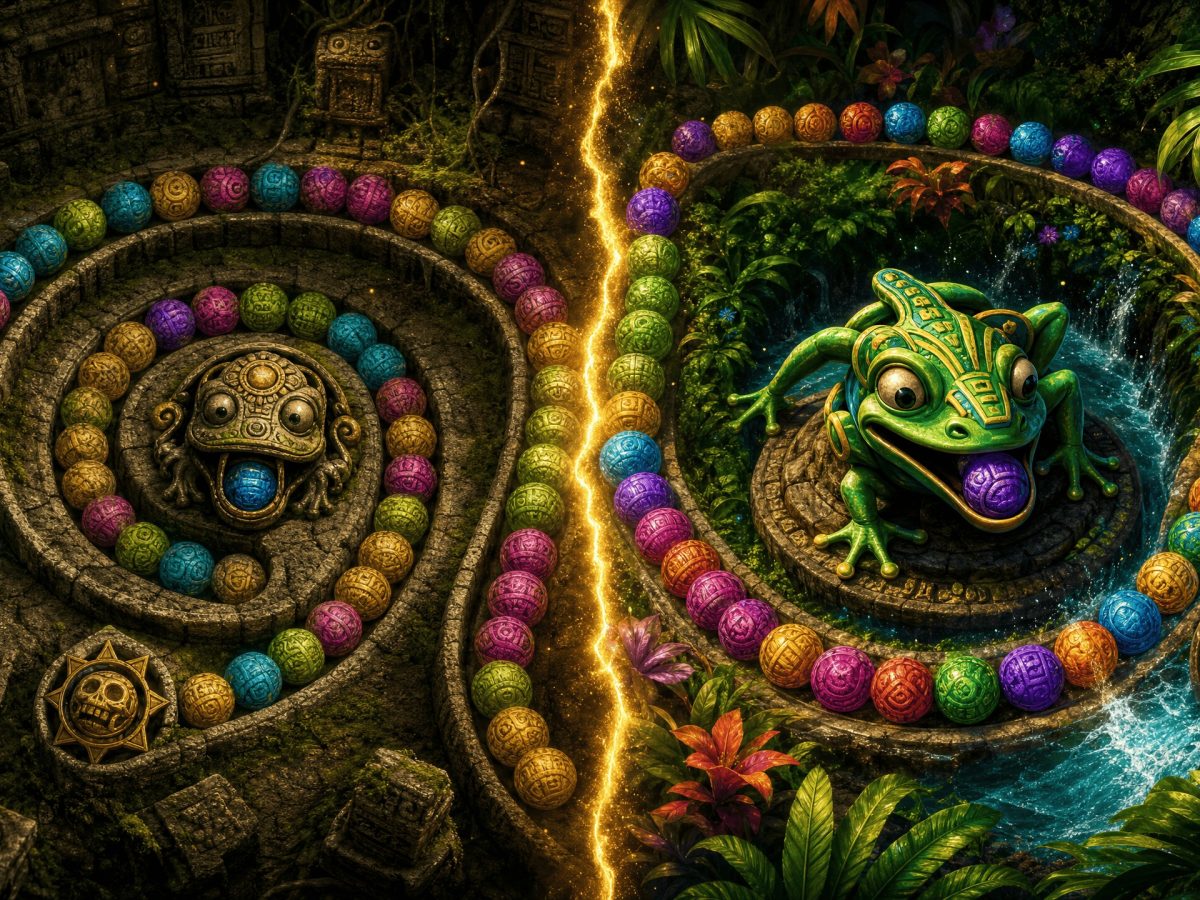
Zuma Deluxe (2003) and Zuma's Revenge (2009) are both PopCap originals — six years apart, made by the same studio, sharing the same core marble-shooter loop. But they’re not the same game. Deluxe is the focused, polished original; Revenge is the more ambitious sequel with split tracks, boss fights, and lily-pad levels. The question “which one should I play?” comes up constantly in Zuma communities. This comparison breaks down what’s different — graphics, tracks, modes, difficulty — and which one suits which player.
TL;DR — The Quick Verdict
If you want the cleanest, most focused marble-shooter experience: Zuma Deluxe. If you want more variety, harder challenges, and modern polish: Zuma’s Revenge. Most fans of the genre play and enjoy both. Deluxe is the shorter, tighter game; Revenge is the longer, more ambitious one. Neither is objectively “better” — they’re aimed at different moments in a marble-shooter player’s journey.
At a Glance: Side-by-Side Comparison
The table below summarizes the key differences. The rest of the article unpacks each one.
| Feature | Zuma Deluxe | Zuma’s Revenge |
|---|---|---|
| Release year | December 12, 2003 | September 15, 2009 |
| Developer | PopCap Games | PopCap Games |
| Setting | Aztec temples | Tropical island |
| Visual style | 2003-era 2D, single resolution | HD, modern wide-screen |
| Tracks | Single path per level | Single plus split (dual paths) |
| Boss battles | None | Six tiki boss fights |
| Frog mechanics | Stationary frog only | Stationary plus lily-pad hopping |
| Game modes | Adventure, Gauntlet | Adventure plus multiple unlockable modes |
| Total content | ~60 levels across 12 stages | ~70 levels plus boss arenas |
| Difficulty curve | Steady, linear escalation | More varied, sharper spikes |
How They Actually Compare
Visual Presentation
Six years separates the two games, and it shows. Zuma Deluxe’s graphics are confidently 2003 — clean, readable, but unmistakably from the era when 1024×768 was a high-end resolution. Marbles are simple colored spheres; backgrounds are static Aztec temple art; effects are minimal but functional.
Zuma’s Revenge ships with high-definition graphics built for the wider monitors and stronger hardware of 2009. Marbles have softer rendering and animated effects when popped. Backgrounds depict a tropical island with active fauna and water effects. The visual upgrade isn’t just polish — the cleaner art makes some late-game tracks easier to read because color contrast is sharper.
Track Design and Level Variety
The single biggest mechanical difference between the two games is track variety.
Zuma Deluxe sticks to single tracks — one chain, one path, one set of curves per level. Levels span 12 stages organized into four Aztec temples. Some tracks are simple curves; others spiral or fold back on themselves, but it’s always one chain to manage at a time.
Zuma’s Revenge adds split tracks. Some levels feature two simultaneous chains traveling along separate paths, forcing you to manage threats on both sides of the screen. This single addition transforms how you approach planning — you’re no longer choosing what to shoot within one chain, but which chain to prioritize first. It’s a meaningful escalation of the genre’s complexity, and it’s the headline difference fans usually mention when comparing the two.
Boss Battles and Special Stages
Zuma Deluxe has no boss fights. Levels build in difficulty across stages but always operate on the same core mechanic — clear the chain, advance to the next level. The closest thing to a “boss” is the harder track in the final stages.
Zuma’s Revenge introduces six tiki boss battles. Each boss is a different giant frog enemy with unique attack patterns and weaknesses, breaking the standard track-clearing loop into a directed combat encounter. Some bosses require hitting specific weak points; others change the playing field mid-fight. They’re not punishingly hard, but they’re a genuine departure from the standard format and add memorable set-pieces that Deluxe simply doesn’t have.
Power-Ups and Frog Mechanics
Both games share the basic power-up vocabulary: explosive marbles, slow-down, reverse, accuracy. Zuma’s Revenge adds more situational power-ups and tweaks how some of them trigger. If you’ve internalized the power-up timing rules from Deluxe, they transfer cleanly to Revenge.
The bigger mechanical change is the lily-pad hopping levels in Zuma’s Revenge. In standard levels, the frog stays centered like in Deluxe. But certain stages let the frog hop between lily pads, adding a positional layer to gameplay — you choose where to fire from, not just what to fire. It’s not used in every level, but when it appears, it’s a meaningful change.
Difficulty and Progression
Zuma Deluxe has a steady, classic difficulty curve. Stages 1–3 are forgiving; stages 4–6 introduce purple as a fifth color; stages 7+ add white as a sixth color. Chain speed and length escalate steadily. Most players can clear the game with practice over a few sessions.
Zuma’s Revenge has a more varied curve, partly because it has more types of content. Standard levels follow a similar progression to Deluxe but tend to be slightly faster and longer. Boss fights interrupt the rhythm with their own difficulty spikes — some are easier than the surrounding levels, others much harder. Lily-pad levels add their own short learning curve. Overall, Revenge is harder than Deluxe by reasonable measures, but the difficulty is less linear and more uneven.
Modes and Replay Value
Zuma Deluxe ships with Adventure mode and a separate Gauntlet score-attack mode. Replay value is mostly about clearing the same levels with better scores or progressing further in Gauntlet.
Zuma’s Revenge offers Adventure plus several unlockable modes — variations like Iron Frog and Heroic Frog that limit lives or modify rules, plus weekly challenge content in some versions. There’s simply more game in Revenge, both in raw level count and in mode variety. Players who want to replay endlessly will find more to do.
Where Zuma Deluxe Wins
Deluxe wins on focus. There’s exactly one mechanic, executed perfectly. No boss fights to break the rhythm, no split tracks to divide your attention, no lily-pad levels to learn. The result is a tighter, more meditative experience — you settle into the flow and stay there. The original Aztec aesthetic is also more iconic than Revenge’s tropical setting; the stone frog, the snake mouth, and the skull pit are the visual identity of the entire genre. For purists, casual returners, or anyone who wants the canonical experience without modern feature creep, Deluxe is the right answer.
Where Zuma’s Revenge Wins
Revenge wins on variety. More levels, more modes, more visual polish, and more types of content. Boss fights and lily-pad levels add memorable set-pieces that Deluxe doesn’t have. Split tracks add a strategic layer that genuinely deepens the gameplay. The HD graphics still hold up well in 2026, while Deluxe’s 2003 art is starting to feel its age on modern monitors. For players who want the most game-for-time-invested in a marble-shooter, Revenge offers more without losing the franchise’s core appeal.
Zuma Deluxe or Zuma’s Revenge: Which Should You Play First?
If you’ve never played either, start with Deluxe. The simpler design teaches the genre’s mechanics cleanly without the distractions Revenge adds, and the original aesthetic is what most readers picture when they think of Zuma. After clearing Deluxe — or even just getting close to clearing it — move to Revenge for the next-level experience.
The progression feels natural: Deluxe teaches the rules, Revenge expands them. Playing Revenge first works too, but Deluxe afterward often feels too sparse, while the reverse order makes Revenge feel like a genuine step up. Almost every long-time Zuma player followed the Deluxe-then-Revenge path, and there’s a reason it became the standard.
Should You Play Both?
Yes, and most fans do. The two games occupy different moods. Deluxe is for short, focused sessions when you want pure mechanics. Revenge is for longer sessions when you want variety. Owning both gives you the full PopCap-era Zuma experience, and they’re inexpensive enough that there’s no real reason to choose one over the other long-term. They’re sibling games, not competitors.
Frequently Asked Questions
Which Zuma game is best?
Neither is objectively best — they aim at different things. Zuma Deluxe (2003) is the focused, classic original with cleaner mechanics and the iconic Aztec aesthetic. Zuma’s Revenge (2009) is the more ambitious sequel with split tracks, boss battles, and modern graphics. For pure marble-shooter purists, Deluxe wins. For variety and polish, Revenge wins. Most fans enjoy both for different moods.
Is Zuma’s Revenge harder than Zuma Deluxe?
Generally yes, but the difficulty isn’t linear. Revenge’s standard levels run slightly faster and longer than Deluxe’s, and boss fights and lily-pad levels add difficulty spikes Deluxe doesn’t have. That said, some of Revenge’s modes are easier than others, and Deluxe’s later stages can be brutal in their own right. Skilled players find both challenging at high-score targets.
Do Zuma Deluxe and Zuma’s Revenge share the same controls?
Yes. Both use mouse-only controls — move to aim, left-click to fire, right-click to swap loaded marbles. Zuma’s Revenge adds positional input on lily-pad levels (clicking a different lily pad to move the frog), but the core firing controls are identical. Skills from one transfer directly to the other.
Can I play either game online, or do I need to download?
The official PopCap versions of both games are paid downloads available through the EA app and major game retailers. Browser-based ports of both games exist on game portals, though their fidelity varies. The desktop downloads remain the canonical way to play, but free browser versions are a fair starting point if you want to try before buying.
Are there any other Zuma games besides these two?
Yes. Zuma Blitz (2010) was a Facebook-only social adaptation that shut down in March 2017 and is no longer playable. The original Zuma (also 2003, predating Zuma Deluxe by a few months) was a simpler edition that Deluxe mostly superseded. The full franchise timeline is covered in our history of Zuma games.
Which game is shorter?
Zuma Deluxe is slightly shorter, with around 60 levels across 12 stages organized into four Aztec temples. Zuma’s Revenge has around 70 standard levels plus six boss fights and additional unlockable modes, making it the longer game. A skilled player can clear either in 6–12 hours of focused play, with Revenge taking longer when modes are factored in.
Where to Play Each
Both Zuma Deluxe and Zuma's Revenge are available as downloadable purchases through EA’s catalog, with the canonical versions running on PC and Mac. Browser-based ports of both games appear on various game portals, including the entries in our 2026 ranking of the best Zuma games. If you’re new to the format, the complete beginner’s guide covers the rules and mechanics that work identically in both titles.


