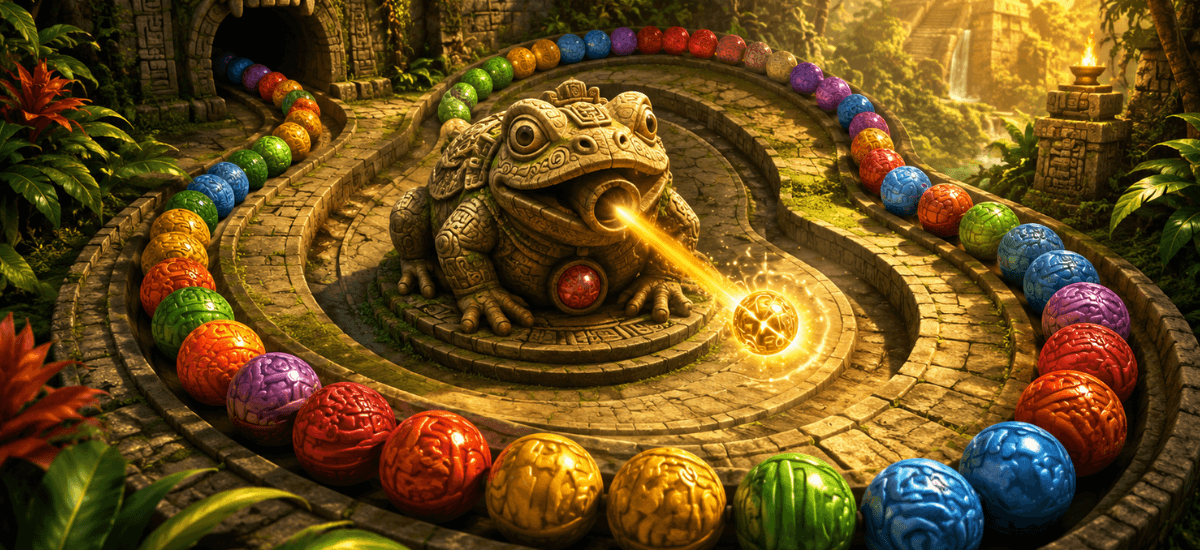
This page is about Zuma games — where they came from, who made them, and how a small Seattle studio’s 2003 puzzler grew into a whole sub-genre with its own name. If you’ve ever fired a colored ball out of a stone frog’s mouth and watched the chain stop just inches from the skull, you already know why the format stuck around for two decades.
Where Zuma Came From
 The story actually starts five years before PopCap touched it. In 1998, the Japanese developer Mitchell Corporation released a coin-op arcade game called Puzz Loop, marketed outside Japan as Ballistic. The mechanic was new at the time: a chain of colored balls advancing along a track, a shooter at the center that flicks balls into the line to make matches, and a single rule — don’t let the chain reach the end. Puzz Loop was clever, but it stayed in arcades and never broke into the wider casual market.
That’s where PopCap Games came in. PopCap had been founded in 2000 by John Vechey, Brian Fiete, and Jason Kapalka, three programmers from Seattle who originally incorporated under the name Sexy Action Cool and funded their first projects with a strip-poker browser game. By 2003 the studio had already released Bejeweled and was looking for a second hit with the same instant-pickup quality. Kapalka and his small team took the Puzz Loop idea, simplified the visual language, added a stone frog as the shooter, set the whole thing in Aztec ruins, and called it Zuma.
PopCap was upfront about the lineage. Founder Jason Kapalka publicly acknowledged the studio’s debt to Puzz Loop and said he was fine with other developers building on the same idea, as long as they added something to it. Mitchell Corporation initially considered legal action over the resemblance, but no lawsuit ever went forward, and the marble-shooter genre quietly opened up.
The 2003 Release: Zuma and Zuma Deluxe
The original Zuma launched in 2003 across an unusually wide set of platforms for a casual title — PCs, PDAs, mobile phones, and even the iPod. The same year, on December 12, PopCap released Zuma Deluxe, the version most players today still recognize. Deluxe added more polished graphics, additional power-up balls, an Adventure mode with thirteen stages spread across four temples, and a Gauntlet practice mode for replaying levels at higher difficulty.
The setup was simple enough to teach in a single sentence: a stone frog in the center of the screen swallows colored balls and spits them at a chain rolling along a track. Match three or more in a row and they pop. Let the chain reach the golden skull and you lose a life. The whole game had only those rules, and roughly seventy-six levels expanded on them with longer tracks, faster speeds, more colors (the palette grows from four to six over the course of the campaign), and a final secret stage called Space with no visible path at all.
Zuma Deluxe was ported widely after its initial PC release. It came to Xbox Live Arcade for the Xbox 360, to PlayStation Network for the PlayStation 3 (where it shipped bundled with Bejeweled 3 and Feeding Frenzy 2), and remained in regular distribution on RealArcade until that platform shut down in 2013. RealArcade named it Game of the Year for 2004.
Zuma’s Revenge and the Later Sequels
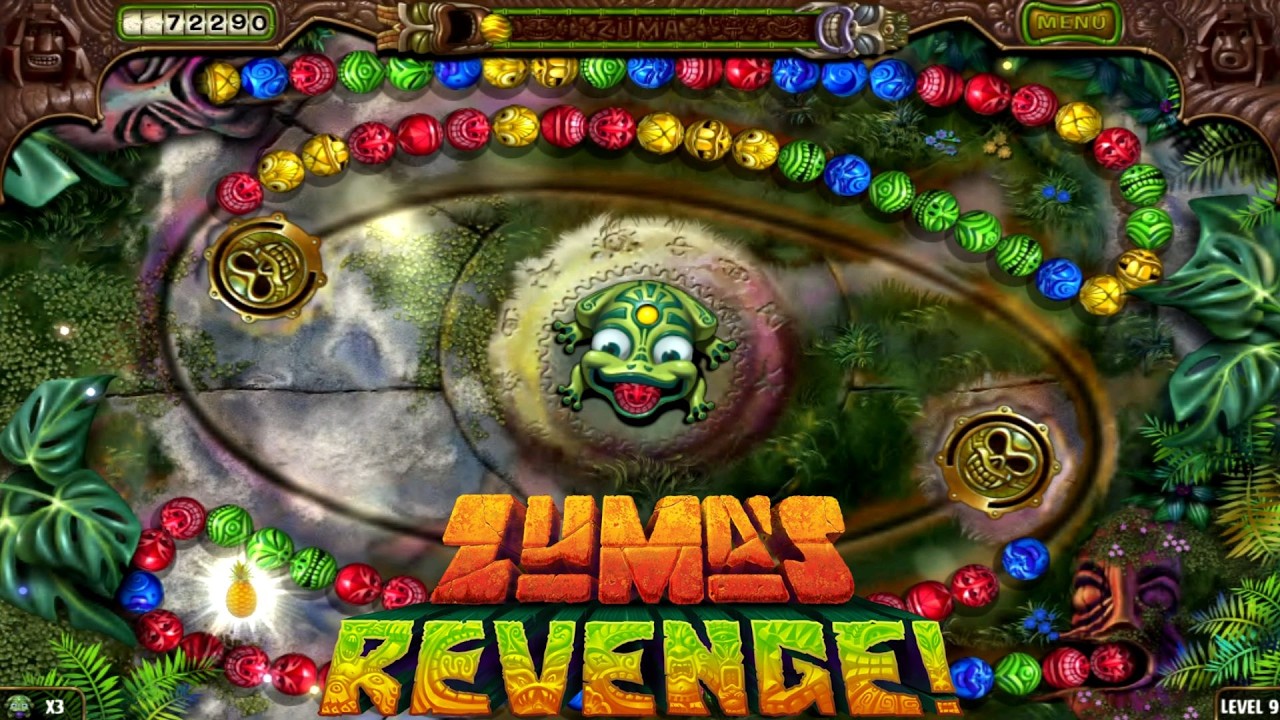
Six years passed before PopCap returned to the franchise. Zuma’s Revenge launched on September 15, 2009 for Windows and Mac, and it was a clear step up: high-definition graphics, boss battles, and three new types of levels that broke the old “rotate-only” frog pattern. In some stages the frog jumped between lily pads. In others, it slid along a horizontal or vertical track and aimed by sliding rather than turning. The Adventure mode dropped the Aztec setting in favor of a Polynesian island ruled by an angry god named Zhaka Mu.
Reviews were mostly positive. IGN gave Zuma’s Revenge an 8 out of 10, calling out the boss fights and the offbeat humor; the main criticism was that the core loop hadn’t changed much, which for fans was actually the point. A Nintendo DS port followed in February 2011, adding daily challenges and a versus mode.
Then came Zuma Blitz, which went live on Facebook on December 14, 2010. PopCap pitched it as the social adaptation of the franchise — shorter rounds, leaderboards, and the first time the series ever had a competitive component. Like most Facebook games of that era, it was eventually retired.
PopCap’s Acquisition by Electronic Arts
On July 12, 2011, Electronic Arts acquired PopCap Games. The studio became an EA subsidiary and is still headquartered in Seattle. PopCap’s mid-2000s flagship franchises — Bejeweled, Peggle, Plants vs. Zombies, and Zuma — all continued under EA, though active development on Zuma specifically slowed down after Zuma Blitz. The original Zuma Deluxe is still sold as part of EA’s casual catalog today.
The Frog, the Skull, and the Aesthetic
Part of the reason Zuma stuck in people’s memories is that it wasn’t just a mechanic — it was a look. The stone frog idol, the carved jungle temples, the slow opening of the skull jaw as the chain crept closer, the four-note motif on the menu that quietly references Close Encounters of the Third Kind. None of that was strictly necessary for a chain-matching puzzler. PopCap added it anyway, and the result is one of the few casual games from that era that people can still describe visually two decades later.
The Aztec-Mesoamerican framing also gave each new “Zuma-style” game an excuse to rebrand. Once the genre opened up, dozens of inspired titles picked their own settings — Egyptian, Atlantean, jungle, panda, pirate, candy. Most of them are still floating around as browser games today, including a number of titles in our own catalog.
The Browser Zuma Renaissance
The reason a site like this one exists at all is that Zuma’s gameplay translated well to the browser. The Flash and early HTML5 era produced a long wave of marble-shooter games inspired by the PopCap formula — some good, many forgettable. With Flash gone, the surviving titles are almost all HTML5 ports or rewrites, which means they run on any modern phone or laptop without a plugin.
For players coming back to the genre after years away, the most useful starting points are still the closest descendants of the 2003 game. Zuma Deluxe remains the cleanest browser version of the classic experience. Zuma's Revenge-style ports add the boss fights and movement variations of the 2009 sequel. For anyone who’d rather read the rules first, our how to play Zuma guide walks through the basics in a few minutes.
Why Zuma Still Matters
By the late 2000s, “Zuma-like” had become a recognized sub-genre — alongside “match-3” and “tower defense” — listed in casual gaming publications and grouped with Bejeweled and Peggle as one of the small set of titles that defined the PopCap era. Zuma also appears in the book 1001 Video Games You Must Play Before You Die, and the Wikipedia entry on the original game remains the most exhaustive single reference for level structure and version history.
The other reason it matters is demographic. Marble-shooters of this style have one of the steadiest 45-and-up audiences in casual gaming. The pacing rewards patience, the controls don’t punish slower reflexes, and the loop is restful in a way most modern free-to-play games aren’t. That’s a small thing, but it’s why Zuma communities are still active — and why a site dedicated to keeping the games playable in a browser still has a reason to exist.
Frequently Asked Questions
Who created Zuma?
Zuma was developed and published by PopCap Games, a Seattle studio founded in 2000 by John Vechey, Brian Fiete, and Jason Kapalka. Kapalka is credited as the director on the original Zuma Deluxe and led most of the design work.
When was the original Zuma released?
The original Zuma launched in 2003 across multiple platforms, and Zuma Deluxe — the most widely played version — was released for Windows on December 12, 2003, with a Mac OS X release following in early 2006.
What is Zuma Deluxe?
Zuma Deluxe is the enhanced PC version of the 2003 original. It added more polished graphics, an Adventure mode with thirteen stages and roughly seventy-six levels, a Gauntlet practice and survival mode, and the power-up balls most players associate with the franchise today.
Was Zuma the first marble-shooter game?
No. Zuma’s gameplay is based on Puzz Loop, a 1998 arcade game by the Japanese studio Mitchell Corporation, which was marketed outside Japan as Ballistic. PopCap acknowledged the influence, and added its own Aztec-style presentation, difficulty curve, and stone-frog shooter on top of the core idea.
Is Zuma still owned by PopCap?
PopCap was acquired by Electronic Arts on July 12, 2011, so the Zuma franchise now sits in EA’s casual catalog. PopCap still operates as an EA subsidiary based in Seattle, though new entries in the Zuma series have been rare since 2010.
How many Zuma games are there?
The main PopCap series has three titles: Zuma (2003, including the Zuma Deluxe expansion), Zuma’s Revenge (2009), and Zuma Blitz (2010, Facebook-only and now retired). Beyond those, there are dozens of inspired browser titles, many available in our classic Zuma category.
Continue Exploring
- Zuma Deluxe Original — the closest browser version of the 2003 PopCap classic.
- Zuma's Revenge — the 2009 sequel, with boss battles and Polynesian theming.
- How to Play Zuma — rules, controls, and a few opening tips for new players.
- Browse all marble-shooter games — the full catalog, sorted by theme and difficulty.